4 Time Management Tips That Actually Work
Four lessons from endurance training on protecting the important things before urgent things take over your day.
 Đoàn Nguyên Hiệp
7 min read
When I train for an Ironman, I never have enough time.
There is swimming, cycling, running, strength work and recovery. On top of that, there is a business to run and a family I want to be present for. A training plan does not give me more hours. It forces me to decide which hours matter.
That, I believe, is the real lesson of time management. Urgent things will always fill your day: messages, small requests, problems that seem to need an answer right now. Important things rarely shout. Your health, your best work, the skill that could change your income, the people you love — none of them send you notifications.
If you let urgency decide, the important things get whatever time is left. Usually, that is nothing.
Here are four time management tips that actually work — not because they are clever, but because they are simple enough to follow in a busy week.
Why most time management advice fails
Most people do not have a time problem. They have a priority problem dressed up as a time problem. The usual mistakes look like this:
- Every task looks equal. A long to-do list puts “reply to that email” next to “build the thing that changes my future”, and the easy task wins.
- The best work is saved for later. We plan to do the important work when we have more energy — and later, we have less.
- Deadlines replace schedules. We wait until the pressure arrives, then rush. The work gets done, but rarely well, and never calmly.
Each tip below fixes one of these problems.
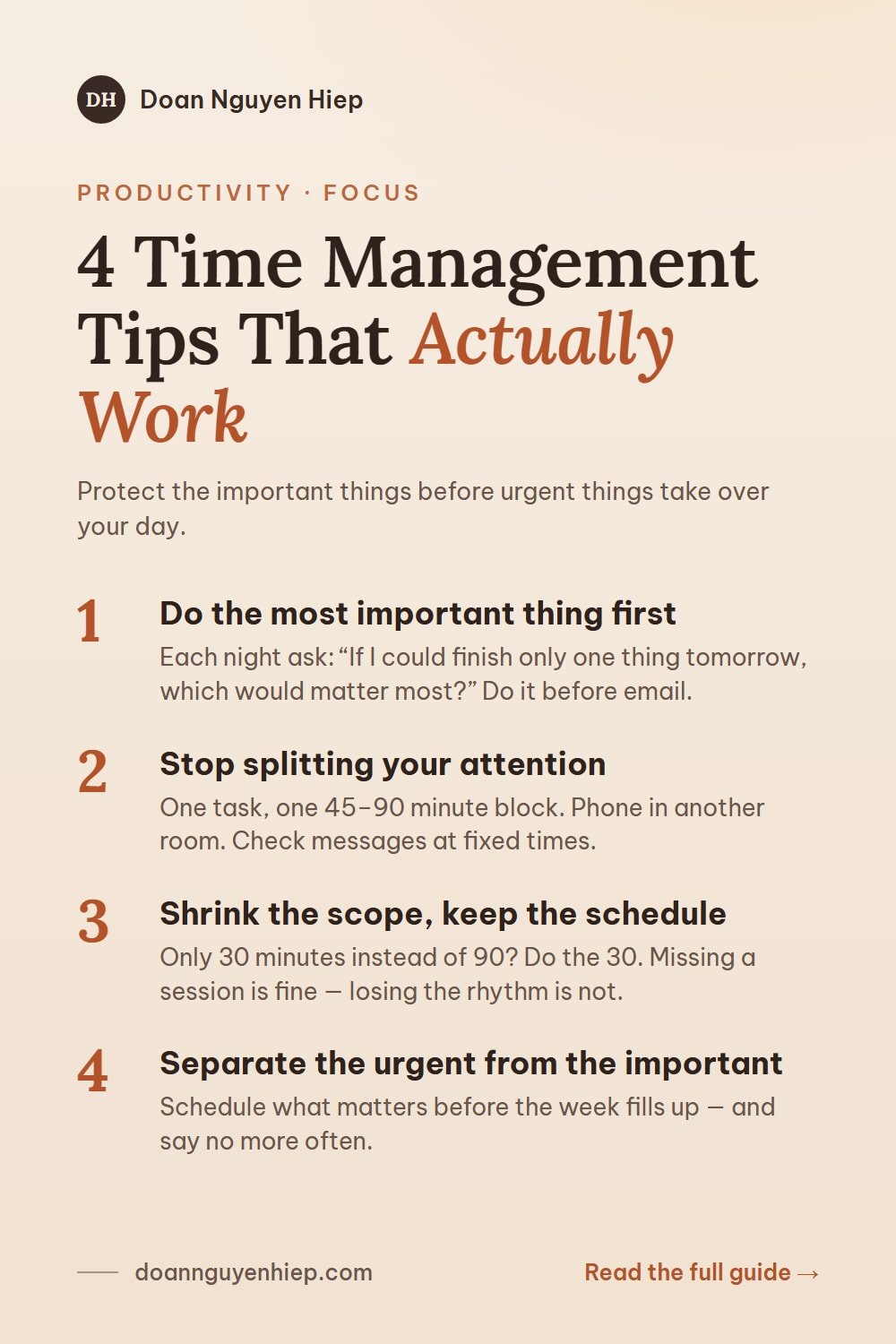
1. Do the most important thing first
Your day gets louder as it goes. In the early hours, the inbox is quiet, nobody needs you yet and your mind is fresh. By the afternoon, small requests and decisions have used up much of your focus.
In training, I learned to do the key session of the week early, before the day has a chance to take it. If the long ride is planned for the evening, something always seems to come up. If it is done at 6 a.m., it is done.
Work the same way. Each evening, ask one question:
“If I could finish only one thing tomorrow, which one would make the biggest difference?”
Write that task down. Tomorrow, do it before you open email or messages — even if you can only give it 60 to 90 minutes. The urgent things will still be there when you finish. The important thing might not have been, if you had started with them.
2. Stop splitting your attention
Many people work eight hours and make three hours of real progress. The rest disappears into switching: writing a paragraph, checking a message, returning to the paragraph, glancing at the phone, starting again.
Every switch has a cost. When you move from one task to another, part of your mind stays behind on the first one. Researchers call this attention residue. You feel busy all day, yet the important work moves slowly.
On a long training ride, the hours where I am fully present — watching my effort, my breathing, my nutrition — are the hours that make me better. The same hours spent half-distracted are just time on the bike.
To protect your attention:
- Work in blocks. One task, one block of 45 to 90 minutes, then a real break.
- Put the phone in another room, not face-down on the desk.
- Batch your messages. Check email and chats at two or three fixed times a day instead of whenever they arrive.
- Close everything you do not need before you begin, not after you notice you are distracted.
One fully focused hour is worth more than three distracted ones.
3. Shrink the scope, keep the schedule
Every week has a few days that go wrong. A meeting runs late, a child gets sick, a problem lands on your desk. On those days, most people skip the important work completely and promise to catch up tomorrow.
In training, I do the opposite. If I planned a 90-minute run and only have 30 minutes, I run for 30 minutes. The workout is smaller, but the schedule survives. Missing one session is not a disaster. Losing the rhythm is.
There is a useful difference here:
- A deadline tells you when something must be finished.
- A schedule tells you when you will work on it.
Deadlines create pressure. Schedules create progress. When time is short, keep the appointment with your important work and reduce the size of the task. Plan three sizes in advance — a full version (90 minutes), a reduced version (45 minutes) and a minimum version (15 minutes) — so you never have to decide on a bad day. It is the same idea I use for habits in How to Build Good Habits That Actually Stick: always have a version you can do on your worst day.
4. Separate the urgent from the important — and learn to say no
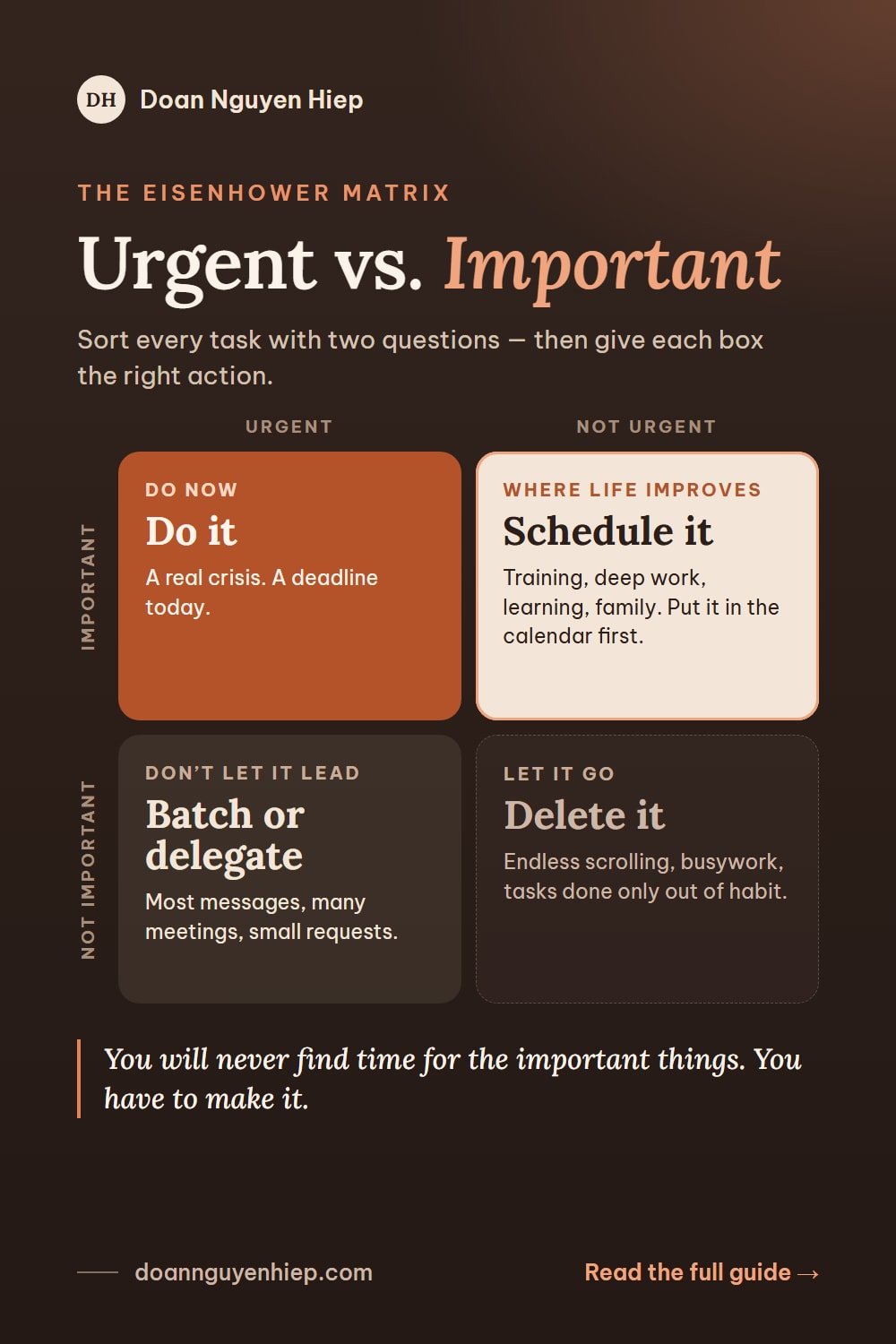
A simple tool for this is the Eisenhower matrix, named after U.S. President Dwight D. Eisenhower. Sort every task by two questions — Is it important? Is it urgent? — and you get four boxes:
- Important and urgent — do it now. A real crisis, a deadline today.
- Important, not urgent — schedule it. Training, deep work, learning, planning, time with family. This is where your life actually improves.
- Urgent, not important — batch it or delegate it. Most messages, many meetings, small requests from others.
- Neither — delete it. Endless scrolling, busywork, tasks that exist only out of habit.
The second box is the one that matters most, and the one that is easiest to neglect, because nothing in it ever demands attention. That is why it has to be scheduled first, before the week fills up.
This also means saying no more often. Every yes has a cost: when you agree to something, you are also choosing not to use that time for something else. Economists call it opportunity cost. Before you accept a new commitment, ask: “What will I have to give up to do this?”
A simple weekly time plan
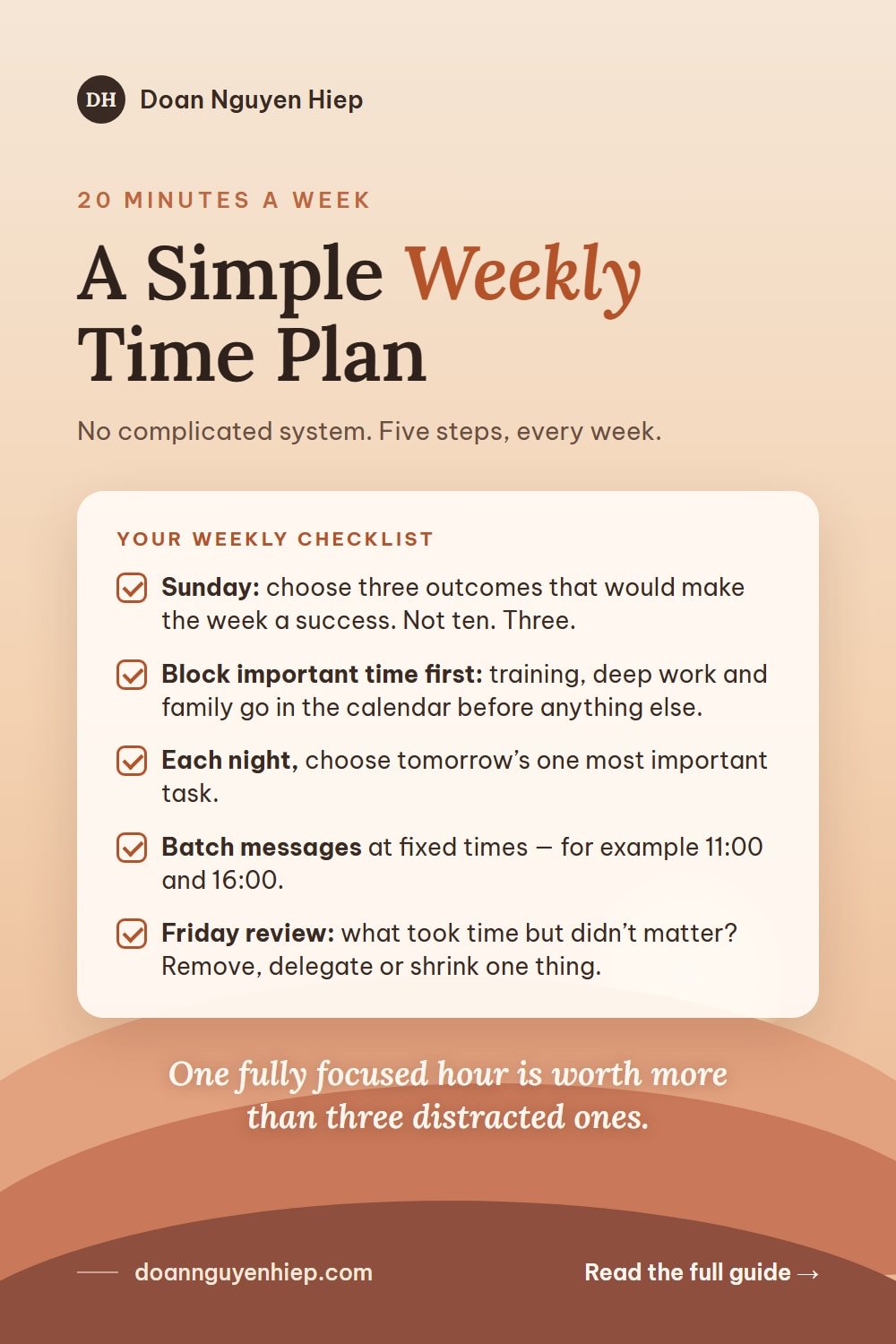
You do not need a complicated system. This plan takes about 20 minutes a week:
- On Sunday evening, choose three outcomes that would make the week a success. Not ten. Three.
- Block important time first. Put training, deep work and family time into your calendar before anything else.
- Each night, choose tomorrow’s one most important task and write it down.
- Batch your messages at fixed times — for example, 11:00 and 16:00.
- On Friday, review the week. What took time but did not matter? Remove, delegate or shrink one of those things next week.
You will never find time for the important things. You have to make it — before the urgent things take it.
Frequently asked questions
What is the best time management technique?
There is no single best technique, but one habit makes the biggest difference for most people: decide your most important task the night before and do it first, in a protected block of time, before checking messages.
How do I manage my time when everything feels urgent?
Ask what would really happen if each task waited a day. Many “urgent” tasks are only loud, not important. Use the Eisenhower matrix: do the urgent and important tasks, schedule the important ones, and batch or delegate the rest.
How many hours of focused work can I do in a day?
For most people, only a few hours of truly focused work are realistic — often two to four. Plan your most important block for the time when your energy is highest, protect it, and use the rest of the day for lighter tasks.
How do I stop procrastinating on important work?
Make the first step smaller. Decide the task the night before, prepare what you need, and commit to just 15 minutes. Starting is usually the hardest part; once you begin, it is much easier to continue.