The 80/20 Rule: How to Use It and When It Holds You Back
The 80/20 rule is one of the most useful ideas in productivity. It also has a hidden downside: it quietly optimizes for your past, not your future.
 Đoàn Nguyên Hiệp
7 min read
If I had used the 80/20 rule to plan my training years ago, I would never have tried an Ironman.
Running was what I knew. It was where my effort produced the most results, where I improved fastest and felt most confident. Any honest 80/20 analysis would have said: keep running, ignore the swimming pool, and forget the bike.
It would have been efficient. It would also have kept me exactly where I was.
The 80/20 rule is one of the most useful ideas I know for focusing on what matters. I use it in business, money, training and daily life. But it has a downside that is rarely discussed, and if you don’t understand it, the same rule that makes you effective today can quietly hold you back tomorrow.
Here is how to use the 80/20 rule well, and how to avoid its trap.
What the 80/20 rule really says
The 80/20 rule, also called the Pareto principle, says that a small share of causes often produces most of the results. It is named after the Italian economist Vilfredo Pareto, who noticed that a small part of the population owned most of the land in Italy.
The numbers are not exact. Sometimes it is 90/10, sometimes 70/30. The point is the imbalance:
- In business, a few customers often bring most of the revenue, and a few others cause most of the problems.
- In money, a few spending categories usually explain most of where your money goes.
- In training, a few key sessions each week create most of the improvement.
- In work, a few tasks create most of the value, while the rest simply fills the day.
Not everything matters equally. That is the whole lesson, and it is a powerful one.
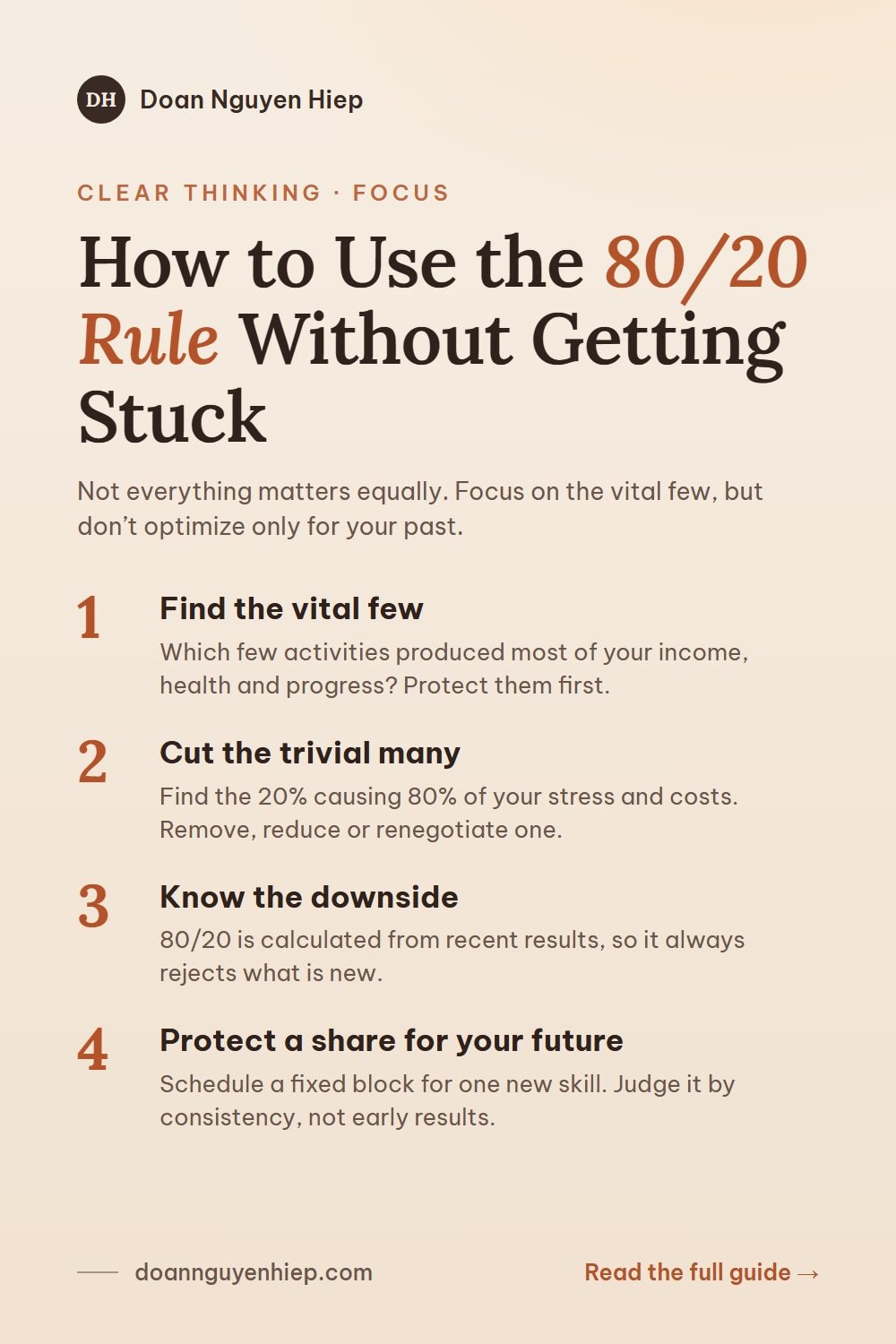
1. Find the vital few
The first way to use the 80/20 rule is to find the few things that produce most of your results, and give them more of your best time and energy.
Look at the last three months and ask:
- Which activities produced most of my income?
- Which habits produced most of my health and energy?
- Which people gave me most of my support, ideas and opportunities?
- Which tasks moved my most important project forward?
You will usually find a short list. Those are your vital few. Protect them in your calendar first, the same way I suggest in 4 Time Management Tips That Actually Work: schedule the important before the urgent fills the week.
Being busy with everything is easy. Being excellent at the few things that matter is rare.
2. Cut the trivial many, and the 20% that causes 80% of the problems
The 80/20 rule works in both directions. A small share of activities may create most of your results, and a small share may also create most of your stress, costs and mistakes.
A useful question comes from inversion: instead of asking only what helps, ask what hurts.
- Which clients or projects cause most of the complaints and late nights?
- Which expenses take the most money while adding the least to your life?
- Which habits (a late phone in bed, one more coffee, skipped recovery) cause most of your bad days?
- Which meetings or commitments take hours and change nothing?
You do not have to remove all of them at once. Remove, reduce or renegotiate one. Often, cutting one source of problems gives you back more time and peace than adding a new productivity system ever could.
3. Know the downside: 80/20 optimizes for your past
Here is the part most people miss.
An 80/20 analysis is always calculated from your recent results. It tells you what has been working. That is useful, but it means the rule naturally favors what you are already good at, and it almost always rejects what is new.
Every new skill is ineffective at the beginning. Your first months of swimming are slow and humbling. Your first podcast episodes take far longer than they should. Your first attempts at a new business, a new language or a new way of investing produce little. If you judge them by 80/20 too early, they will always lose to the things you already do well.
Charlie Munger talked about staying inside your circle of competence. That is wise advice for risky decisions, such as where to invest your savings. But a circle of competence is not fixed. It grows only when you spend some time at its edge, doing things you are not yet good at.
If you only optimize for what works today, you will become very good at the life you already have.
Sometimes that is exactly what you want. But if you want a different future (a new career, a new level of health, a new kind of freedom), the 80/20 rule will rarely show you the way at the start.
4. Protect a share for who you are becoming
The answer is not to stop using the 80/20 rule. It is to use it for most of your time, and deliberately protect a smaller share for your future.
I think of it like an investment portfolio. Most of the money sits in reliable assets. A smaller part is invested for growth, knowing it may take years, and that some of it will not work. You would never put everything into the experimental part. But a portfolio with no growth at all slowly falls behind.
Your time works the same way:
- Most of your time goes to the vital few that already produce results: your core work, your key training sessions, the people who matter most.
- A fixed share (for example, a few hours each week) goes to the skill, project or direction you want to grow into, even though it is not yet effective.
Two rules make this work. First, schedule it, because new things never feel urgent. Second, judge it by consistency, not by early results. A new skill should be measured by whether you showed up, not by how much it paid this month. It is the same idea as starting a habit with a small minimum version in How to Build Good Habits That Actually Stick.
Small investments in your future compound. Today they look ineffective. In a few years, they may be the most effective thing you do.
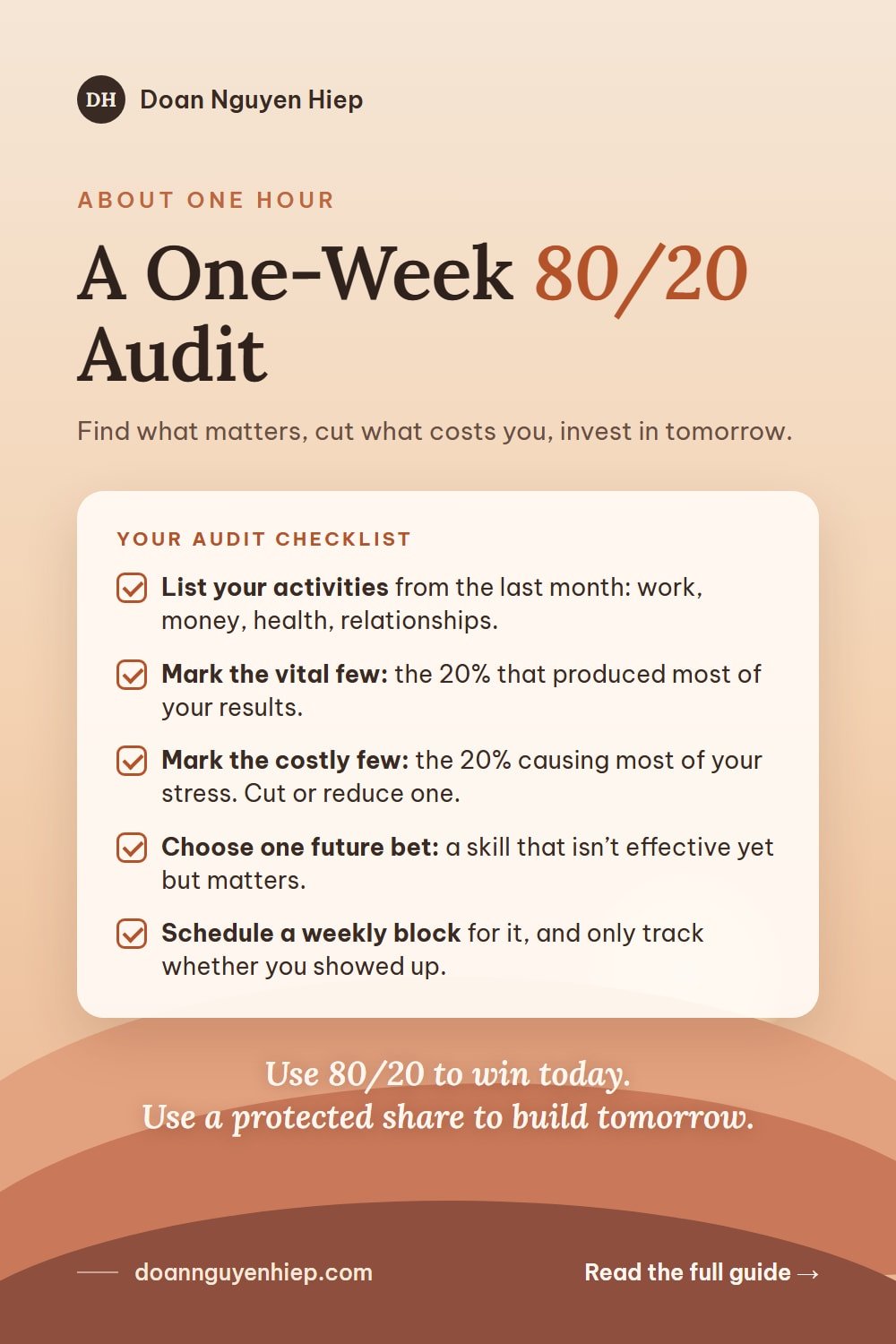
A one-week 80/20 audit
You can do this in about an hour, spread across one week:
- List your activities from the last month: work, money, health, relationships.
- Mark the vital few: the 20% that produced most of your results. Protect them in next week’s calendar.
- Mark the costly few: the 20% that caused most of your stress or problems. Remove, reduce or renegotiate one of them.
- Choose one future bet: a skill or project that is not effective yet but matters for the person you want to become.
- Schedule a fixed block for it every week, and track only whether you showed up.
Use the 80/20 rule to win today. Use a protected share of your time to build tomorrow.
Frequently asked questions
What is the 80/20 rule?
The 80/20 rule, or Pareto principle, is the observation that a small share of causes often produces most of the results, for example, a few customers bringing most of the revenue, or a few tasks creating most of the value.
Is it always exactly 80/20?
No. The numbers vary: it might be 90/10 or 70/30, and the two numbers do not need to add up to 100. The useful idea is the imbalance: results are rarely spread evenly across your efforts.
How do I apply the 80/20 rule to my productivity?
Review your recent work and find the few tasks that created most of the value. Do those first, in protected time. Then find the tasks that take a lot of time but add little, and reduce, delegate or remove them.
When should I not rely on the 80/20 rule?
Be careful when you are learning something new or changing direction. Because the rule is based on recent results, new skills will almost always look ineffective at first. Give them a fixed share of your time and judge them by consistency, not early results.